
A new CAL Research Brief highlights how EL leaders are making the most of what they have in and outside of their classrooms to make sure their students don’t miss out

For Southerners, the term “bless your heart” can be a loaded statement, but Dr. Kia Johnson, CAL’s Senior Director of PK-12 Professional Development and Evaluations, turns the saying on its head with her framework based on research into rural and low-incidence English Learner programs. She found creative and resourceful educators who went into their communities and found inventive and enterprising ways to overcome challenges, including small budgets, and educate their students. Dr. Johnson joins CAL Communications Director Christi Hang to talk about the importance of community, why “bless your heart” isn’t always a slight, and how money doesn’t have to be a critical limiting factor.
Answers have been edited for space and clarity.
CH: Your work is titled “Bless Your Heart Leadership.” For many people, that phrase carries a negative or dismissive connotation. Why did you choose that title, and how are you intentionally reframing what “bless your heart” means?
KJ: As you all know, here in the South, “bless your heart,” can give this dismissive tone. But as I was having the interviews with this specific population of participants, what really struck me was how deeply these coordinators cared about their multilingual learners, even though they only had a handful in their district. The way they talked about them and worked with them, it just sounded like they just wanted to hug them with support. They had this real sense of responsibility and care.
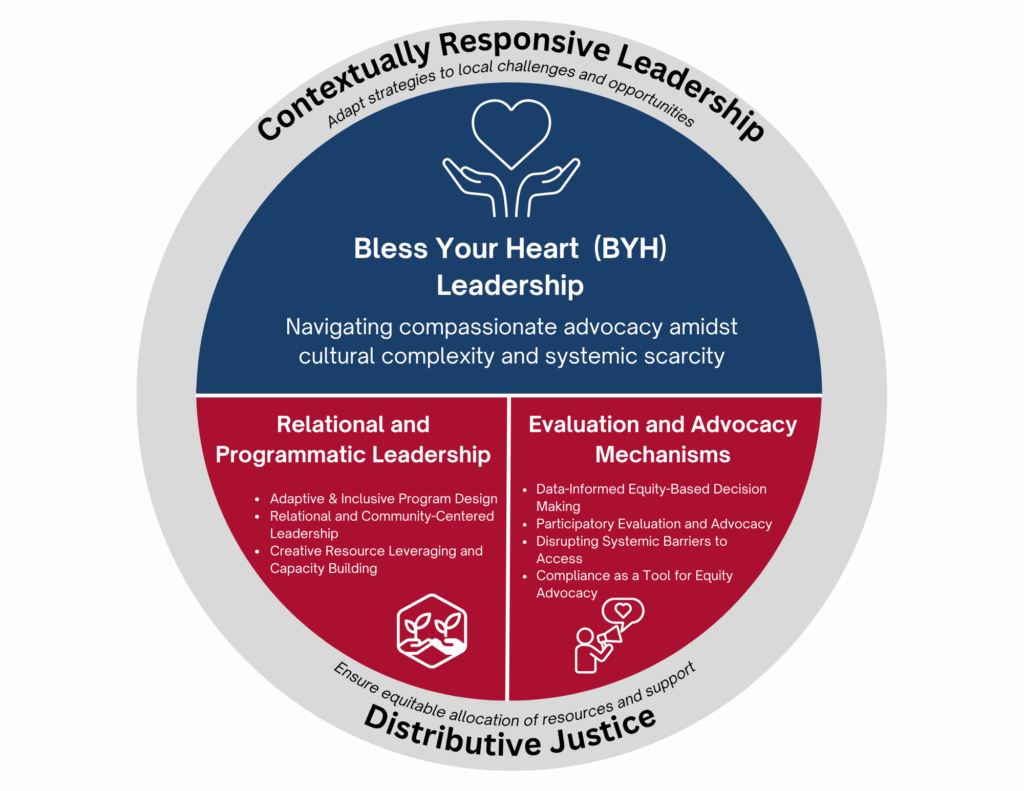
So, in my mind, I started hearing “bless your heart” in a more empathetic and less condescending way. [I listened] to these leaders talking about navigating the complex situations they have, they had limited resources, the demographics are very different for them. Their communities are still learning how to receive and support immigrant families, but here they are in the southern rural spaces, advocating for these very diverse students, having to maintain relationships across all of these stakeholders. And they had to be compassionate while diplomatic and persistent. So, I’ve kind of taken that “bless your heart,” and we’re turning it into this combination of contextual responsiveness, empathy, cultural awareness, and a more positive, empathetic tone toward leadership and equity work.
Read “Bless Your Heart” Leadership: Advancing Equity in Rural and Low-Incidence EL Programs here.
CH: I’d like to dive into your research and how did it lead to the development of the “Bless Your Heart Leadership” Framework?
KJ: I used to work at the Virginia Department of Education, and in that work, I supported these low-incidence districts, when they were planning the funding for their Title III work. So, as I entered my doctoral program, I really wanted to elevate their stories. When I used to visit these districts to monitor them for compliance, I also heard about these wonderful things they were doing in these spaces that are often forgotten, because most of the time, they have a handful of [English Learners]. These districts receive less than $10,000 from Title III funds, which is designated for English Learner programming and the things that they’re able to do, are a pretty amazing, considering that it’s really not supported by Title III funding, even though they have to comply with Title III law.
In this study, I interviewed these coordinators, and what really stood out is that they were extremely adaptive, and they really based their work in relationships. Instead of your traditional leadership models, because a lot of times they had such a small number of English Learners, their districts couldn’t justify having a full-time Title III coordinator. So, these are people who not only were overseeing Title III programs, but they were overseeing maybe the other federal funding for Title I, II, and IV, some of them are special education coordinators, or lead professional development. One of my participants is actually the EL teacher in the district as well, so she had a caseload of the ELs, and was managing the Title III funding and monitoring compliance.
CH: What stood out to you in this new leadership model that they were forging, and were there similarities in how they supported multilingual learners despite different situations?
KJ: They were all very creative, very persistent, very resourceful, and so passionate. That was evident across all participants. There were eight participants total, representing six districts here in Virginia. All of them were working with very small budgets, very limited staff, but they were stretching resources and building these partnerships that I just thought were amazing.
My thinking was these conversations were really going to be complaints of not having enough money and “we’re struggling, and it’s hard, and …” and all of these things, but there was a quote that came from an interview that just really shifted all that thinking. One of the coordinators said, “To me, the money is never the issue.” My jaw just dropped because I thought they would all say they need more money, which is true, but none of them really had this narrative of having limited Title III funding being this barrier, because they were creative in finding other ways to support the students, because it just had to be done. These kids needed it.
They got creative, and they used their community. That was relationship- and place-based work that I was seeing where some of them partnered with local universities to bring in tutors and to support their translation, because they didn’t have the funding to afford a translation partner, so the university provided people for free. They would have instructional assistants that were really dedicated to working with their students, and they were paying for them to become certified ESL teachers by supporting studying for the Praxis test. Another district was taking adult ESL classes to the parents of their elementary school ELs. There was a church next to a neighborhood where most of their ELs came from. And they would do adult EL classes there, so that the parents could just walk over and get their own ESL learning.
CH: That sounded like an unexpected insight about the money not being the problem. Were there any other moments that were unexpected, but nice to discover?
KJ: Another one that really stood out to me is that a lot of times, when you think of having to be compliant with federal law, it’s very a nerve-wracking thing when the state has to come in and monitor you for that. But these districts actually all very much embraced it, because they were using these federal monitoring visits from the state to help them be bureaucratic in their district. It’s a leveraging tool for them, where I even had one coordinator say “an audit is a beautiful thing.” They said that having the state come in and evaluate their program from the federal lens, it gave them the evidence that they might need so they can advocate for their program locally. Because having it [mentioned] in that compliance visit really helps them have those conversations with their superintendent and with their [school] board to say that this is something that the state has identified as a need for us, and it’s not just because I’m wanting it.
CH: This brief is great because it also has examples of real-world application. For educators working in rural and low-incidence EL contexts, what are one or two concrete steps they can take to practice?
KJ: This is contextually responsive, place-bound problem-solving. That is my favorite part of this work. I took some research, got its academic background; there’s your literature review that’s grounded in theory, but I really wanted to highlight the voices in these districts, and offer practical application, because oftentimes it stays very academic, and it’s hard to interpret what to do with that information. One of the two things that I think are the easiest to take away from this and can be implemented quickly is working on relationships. Find ways to connect community organizations, and don’t forget about your local colleges, your public library systems, your other wraparound services, and your families of your multilingual learners. So, using them as untapped community resources to support students in and outside of your buildings is something I think you can start on right now.
And for leaders, especially at the state, or at the district level outside of these Title III coordinators, making sure that there are networks available to those who are running EL programs in these contexts because these leaders often feel very isolated. For example, my study happened in Virginia, and in Virginia, they have the Title III statewide consortium and what Virginia does for those districts is that for everybody who meets that criteria, they make them one big pot of Title III funds from the state, they re-divvy it up so that they actually get a little bit more in per-pupil funding than they would if they were not a consortium district, and then on top of that, the state gives them additional technical assistance, such as webinars.
They also get their own conference in Virginia, so all of the teachers and leaders from just the rural and low-incidence areas come together for a conference led by the state, then they have dedicated support from their Department of Education staff to try to make sure that they’re able to collaborate and network. With that type of model, districts are able to bring what’s working for them and share it amongst themselves. For example, there was a district that was able to share how their program model for ELD led to 100% on-time graduation rate for their high school ELs. The state invited them in to share what they were doing to make that happen with the other consortium districts, so that they could see how it works in that context. [The educators] wouldn’t have gotten that story or that information just being by themselves without that networking opportunity, so making sure that there are some tools and ways for them to network outside of the district with others in similar contexts in rural, low-incidence contexts is something I think that you could start fairly quickly. With even just an email chain, a Facebook group, or webinar series, that doesn’t take a lot…but just having a way for them to be able to share their expertise, make sure they’re all running their programs equitably, and have somebody to lean on when they need that help in being able to justify any services or strategy that they want to implement.
Watch the full discussion:
