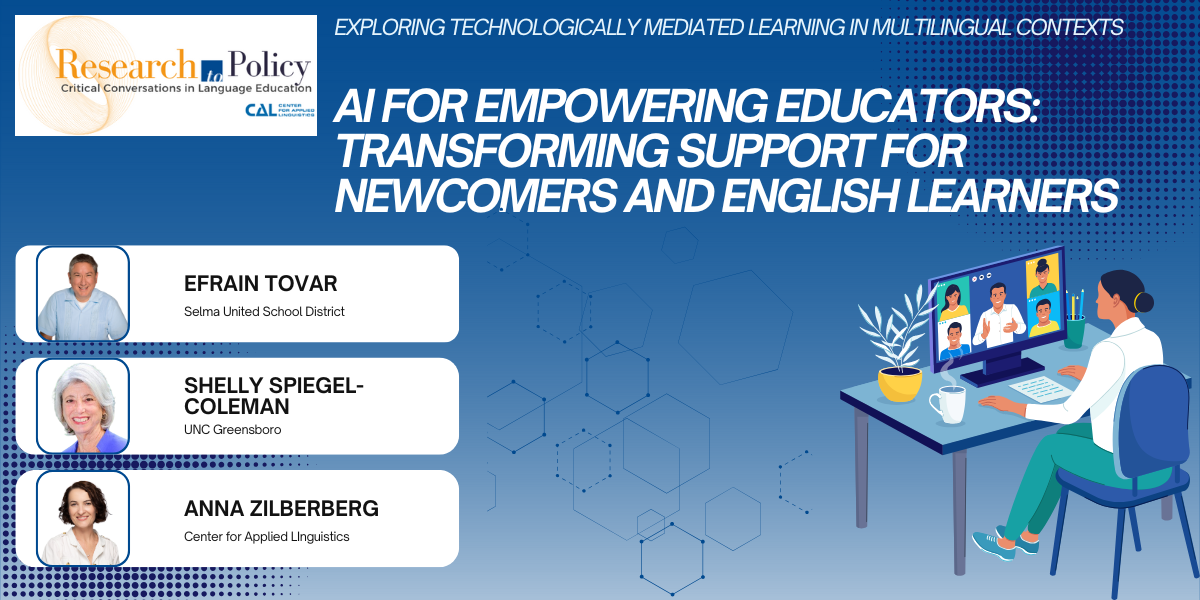
TITLE: AI for Empowering Educators: Transforming Support for Newcomers and English Learners DATE: Jan 29, 2025 TIME: 4:00–4:30 p.m. EDT
DETAILS: Discover how Artificial Intelligence can revolutionize teaching practices for educators working with Newcomers and English Learners. This session explored practical AI tools and strategies to personalize learning, enhance language development, and streamline teacher workflows, empowering educators to better meet the unique needs of multilingual students.
All webinars, recordings, and related materials produced by the Center for Applied Linguistics (CAL) are protected by copyright. They are made available exclusively through CAL’s official platforms for educational and informational purposes.
CAL does not authorize the reposting, redistribution, or resale of our webinars on any third-party websites. Any such uploads are unauthorized and may not accurately represent the original content.
To ensure you are accessing the most accurate, complete, and up-to-date info, please view webinars only through CAL’s official website and communication channels.
TITLE: What Matters: Culturally and Ecologically Responsive Designs DATE: Dec 10, 2024 TIME: 4:00–4:30 p.m. EDT
DETAILS: The rise of AI technology provides unprecedented opportunities to support diverse learners’ language and literacy development. Developing and implementing pedagogical innovation integrating technology to support multilingual learners is not optional, but required, otherwise, many of these learners will fall behind at an accelerating rate, with classroom instruction disconnected from the reality of most learners. During this webinar, panelists will discuss how to integrate technology effectively in advancing diverse learners’ academic vocabulary knowledge, reading and writing skills. They will show lessons learned from their own intervention studies starting from early usage of online dictionaries to support hypertext reading comprehension, moving onto Web 2.0 technologies, such as social media, smart phone technologies to support vocabulary acquisition and academic writing. This leads now onto generative AI-assisted discourse analysis to support corpus-based data driven learning. Critical alignments are required for instructional designs between complex cultural and ecological factors and technology affordance, which significantly impacts the implementation fidelity of language pedagogical innovations—teaching practices—, learner experiences and outcomes.
All webinars, recordings, and related materials produced by the Center for Applied Linguistics (CAL) are protected by copyright. They are made available exclusively through CAL’s official platforms for educational and informational purposes.
CAL does not authorize the reposting, redistribution, or resale of our webinars on any third-party websites. Any such uploads are unauthorized and may not accurately represent the original content.
To ensure you are accessing the most accurate, complete, and up-to-date info, please view webinars only through CAL’s official website and communication channels.
TITLE: Bias in Automatic Speech Recognition: The Case of African American Language DATE: Nov 12, 2024 TIME: 4:00–4:30 p.m. EDT
DETAILS: Many modern technologies, such as Automatic Speech Recognition (ASR) systems, have been shown to have significant racial biases, which can impact many areas of people’s lives. We seek to integrate research on African American Languages into analysis on how ASRs could prove harmful to many speakers. In this webinar, we pose a number of questions for reflection and future work, and offer resources for cross-disciplinary collaboration towards more equitable engagement with technological systems.
RESOURCES
To view the article written by our panelists Kelly Wright and Joshua Martin click HERE.
Important Notice on CAL Webinar Content
All webinars, recordings, and related materials produced by the Center for Applied Linguistics (CAL) are protected by copyright. They are made available exclusively through CAL’s official platforms for educational and informational purposes.
CAL does not authorize the reposting, redistribution, or resale of our webinars on any third-party websites. Any such uploads are unauthorized and may not accurately represent the original content.
To ensure you are accessing the most accurate, complete, and up-to-date info, please view webinars only through CAL’s official website and communication channels.
TITLE: Reverse-Designing Responses to Emerging Technologies in Multilingual Contexts DATE: Oct 08, 2024 TIME: 4:00–4:30 p.m. EDT
DETAILS: Integrating generative artificial intelligence (AI) in higher education presents challenges and opportunities. A reverse design approach can help stakeholders implement these technologies strategically and purposefully. This webinar discusses the Chicago approach to reverse design, its impact on language education, and how this approach can be implemented when shaping responses to generative AI in language education.
All webinars, recordings, and related materials produced by the Center for Applied Linguistics (CAL) are protected by copyright. They are made available exclusively through CAL’s official platforms for educational and informational purposes.
CAL does not authorize the reposting, redistribution, or resale of our webinars on any third-party websites. Any such uploads are unauthorized and may not accurately represent the original content.
To ensure you are accessing the most accurate, complete, and up-to-date info, please view webinars only through CAL’s official website and communication channels.
TITLE: Responsible AI in Assessment DATE: Sep 10, 2024 TIME: 4:00–4:30 p.m. EDT
DETAILS: AI offers significant opportunities for assessments by enabling secure, remote tests that expand access. However, it also poses risks, including the potential for new cheating behaviors, such as using generative AI tools like ChatGPT for writing assistance. As these AI capabilities continue to disrupt traditional assessment methods, integrating Responsible AI (RAI) practices into assessment development and policy becomes crucial. RAI is a global concern, and governments around the world have developed guidelines aimed at mitigating potential harms associated with AI. These guidelines are grounded in ethical principles and aim to identify risks and develop practices that uphold the quality of tests. The webinar highlights the need to develop further and expand RAI principles for assessment practices.
————————————————————————————————————————
Important Notice on CAL Webinar Content
All webinars, recordings, and related materials produced by the Center for Applied Linguistics (CAL) are protected by copyright. They are made available exclusively through CAL’s official platforms for educational and informational purposes.
CAL does not authorize the reposting, redistribution, or resale of our webinars on any third-party websites. Any such uploads are unauthorized and may not accurately represent the original content.
To ensure you are accessing the most accurate, complete, and up-to-date info, please view webinars only through CAL’s official website and communication channels.
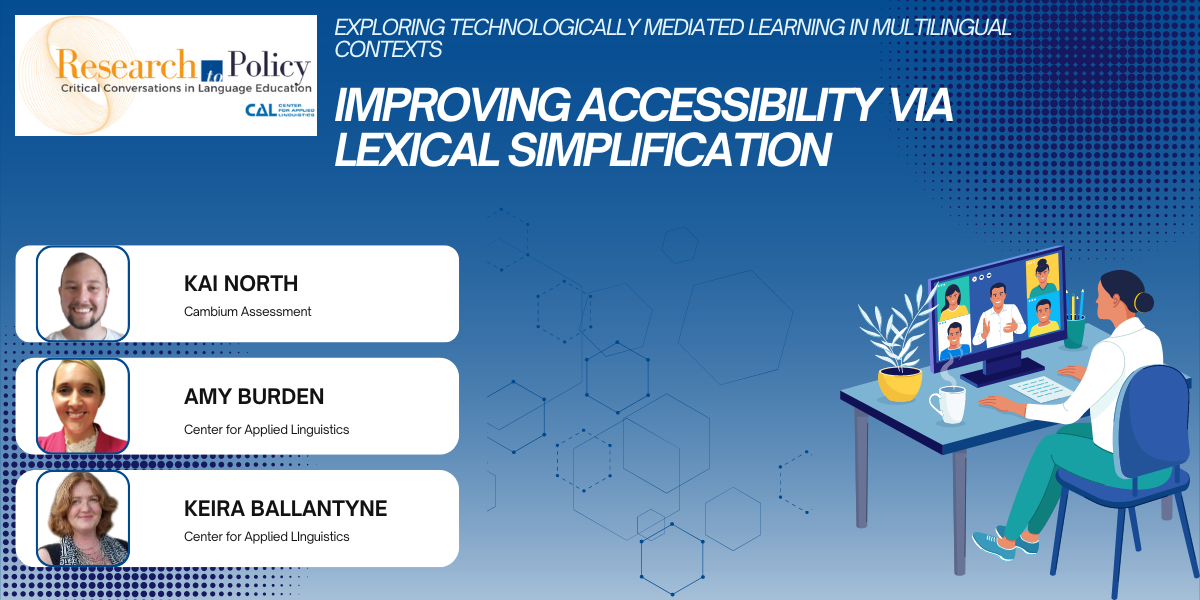
TITLE: Improving Language Accessibility VIA Technologically Mediated Lexical Simplification DATE: Aug 13, 2024 TIME: 4:00–4:30 p.m. EDT
DETAILS: During this webinar, panelists will discuss how Mediated Lexical Simplification can help to improve Language Accessibility. Lexical Simplification (LS) is the task of automatically improving the accessibility and readability of any given text by replacing hard-to-read words with simpler alternatives. LS systems achieve this by leveraging recent advances in AI, including large language models (LLMs), such as GPT 3.5 and others, to suggest several simplified alternatives to an identified complex word that maintains the original text’s meaning. Various LS systems have been designed to improve text accessibility for differing target demographics, including second-language English learners, individuals with a reading disability, or adults with low literacy. However, more collaboration is needed between AI researchers and real-world classroom environments to determine the effectiveness of LS systems.
————————————————————————————————————————
Important Notice on CAL Webinar Content
All webinars, recordings, and related materials produced by the Center for Applied Linguistics (CAL) are protected by copyright. They are made available exclusively through CAL’s official platforms for educational and informational purposes.
CAL does not authorize the reposting, redistribution, or resale of our webinars on any third-party websites. Any such uploads are unauthorized and may not accurately represent the original content.
To ensure you are accessing the most accurate, complete, and up-to-date info, please view webinars only through CAL’s official website and communication channels.
TITLE: Has Artificial Intelligence Rendered Language Learning and Teaching Obsolete? DATE: July 09, 2024 TIME: 4:00–4:30 p.m. EDT
DETAILS:
From the beginning of the first wave of AI, dating back to speech technologies in the early 2000s, there has always been a keen interest in how technologies might be harnessed to facilitate language learning and teaching. Now, almost a quarter century later, there are a number of possible directions language learning and teaching might take as a result of the COVID-19 pandemic and recent technological advances.
AI technologies were originally aimed at developing machines that can use language and “think” abstractly. In this webinar, we look at the potential existential threat AI poses to language teaching and the need to learn a language in the first place. This existential threat sits alongside a decline in language learning opportunities across the English-speaking world.
It is critical that language educators have a more in-depth understanding of what AI is and how it works, in order to fully appreciate the extent to which AI can (or cannot!) replace language teachers and the need to learn a foreign language. We’ll explore what AI is, the range of AI technologies that might be deployed in language teaching, and how those technologies work – and whether AI might really ever replace language teachers.
————————————————————————————————————————
Important Notice on CAL Webinar Content
All webinars, recordings, and related materials produced by the Center for Applied Linguistics (CAL) are protected by copyright. They are made available exclusively through CAL’s official platforms for educational and informational purposes.
CAL does not authorize the reposting, redistribution, or resale of our webinars on any third-party websites. Any such uploads are unauthorized and may not accurately represent the original content.
To ensure you are accessing the most accurate, complete, and up-to-date info, please view webinars only through CAL’s official website and communication channels.
TITLE: Artificial Intelligence and the Future of International Schools DATE: June 18, 2024 TIME: 4:00–4:30 p.m. EDT
DETAILS: Join us as Pascal Vallet, principal at the United Nations International School, explores how technology could transform international schools and similar multilingual PK–12 institutions known for their globally minded curricula, language education opportunities, and diverse communities of multinational students, faculty, and families. Shelly Spiegel-Coleman of Californians Together and Maria Cieslak of the Center for Applied Linguistics will lead the discussion, which will consider the importance of collaboration among educators, policymakers, and technologists to develop technology that supports culturally sensitive teaching, meets international standards, eliminates biases, and fosters global citizenship.
————————————————————————————————————————
Important Notice on CAL Webinar Content
All webinars, recordings, and related materials produced by the Center for Applied Linguistics (CAL) are protected by copyright. They are made available exclusively through CAL’s official platforms for educational and informational purposes.
CAL does not authorize the reposting, redistribution, or resale of our webinars on any third-party websites. Any such uploads are unauthorized and may not accurately represent the original content.
To ensure you are accessing the most accurate, complete, and up-to-date info, please view webinars only through CAL’s official website and communication channels.
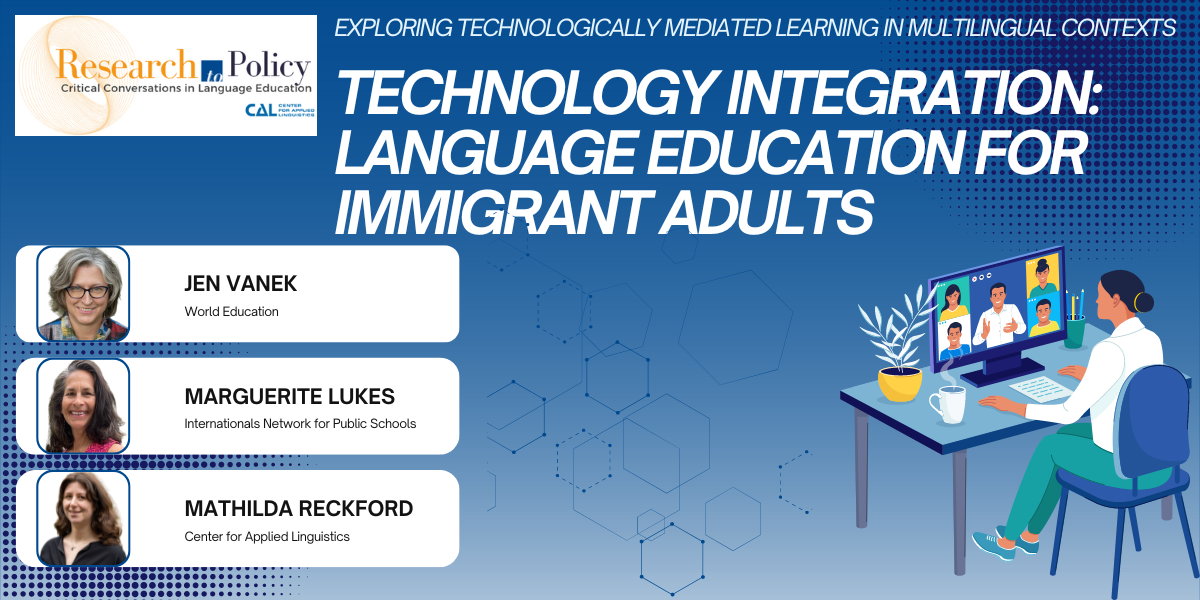
TITLE: Technology Integration: Language Education for Immigrant Adults DATE: May 14, 2024 TIME: 4:00–4:30 p.m. Eastern Standard Time
DETAILS: This webinar explored the impact of digital environments on adult immigrants’ language learning and the challenges faced by multilingual individuals in these settings. Jen Vanek, Director of Digital Learning and Research at World Education, discussed research findings from different studies on improving language instruction and digital literacy through technology. Marguerite Lukes, CAL Board member and Director of Research at Internationals Network for Public Schools, and Mathilda Reckford, CAL Adult Language and Communication Specialist, participated in the conversation to examine policy and practice implications for enhancing language education and digital skill development. The webinar covered technologically mediated learning in multilingual contexts and offered insights on digital inclusion, technology recommendations, support and training for teachers, and the role artificial intelligence could play in multilingual education for adult immigrants.
Resources
Our speaker, Jen Vanek, shared a compilation of resources at this link.
Subscribe to CAL’s Adult Literacy and Language Education newsletter here.
Share the link to EHLS program details to make a difference in the careers of advanced English speakers who are native speakers of Arabic, Chinese Mandarin, Hausa, Kazakh, Korean, Persian Farsi, Russian, Turkish, and Ukrainian here. The application deadline for this year’s EHLS program is June 18, 2024.
————————————————————————————————————————
Important Notice on CAL Webinar Content
All webinars, recordings, and related materials produced by the Center for Applied Linguistics (CAL) are protected by copyright. They are made available exclusively through CAL’s official platforms for educational and informational purposes.
CAL does not authorize the reposting, redistribution, or resale of our webinars on any third-party websites. Any such uploads are unauthorized and may not accurately represent the original content.
To ensure you are accessing the most accurate, complete, and up-to-date info, please view webinars only through CAL’s official website and communication channels.
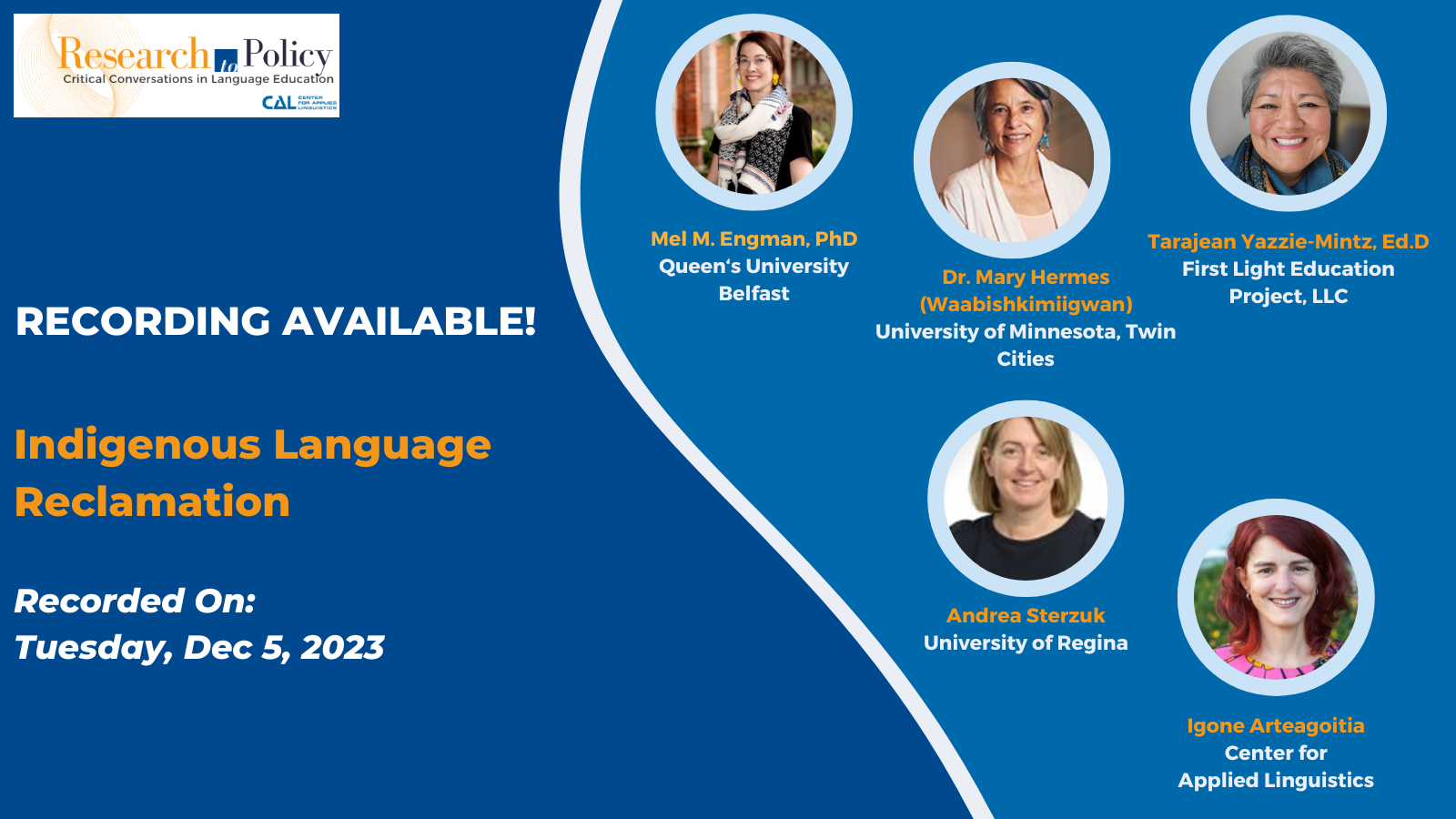
DETAILS: This webinar provided an overview of initiatives in the area of Indigenous language reclamation. Panelists shared about research projects and programs designed to support Indigenous children in connecting to language, heritage, and culture. Webinar attendees heard about what Indigenous-led research said about intergenerational language learning, land-based pedagogy, and the importance of Indigenous languages for early childhood learning.
Q&A UPDATE
Question: When a people lose their language, how do they find it again?
Mary Hermes: You can find your language or one you are connected to by looking to the land of the place you inhabit. Finding other people and classes (online and through tribal colleges) is great.
Question: What is the National Science Foundation document that Mary spoke of?
Mary Hermes: The National Science Foundation science grants are called Documenting Endangered Languages. The document is “Understanding Learning Mechanisms and Language Acquisition Through Intergenerational Conversations in Southwestern Ojibwe, a Native American Language.”
RESOURCES
Forest Walks publications
Engman, M. M., & Hermes, M. (2021). Land as interlocutor: A study of Ojibwe learner language on and with naturally occurring ‘materials’. Modern Language Journal, 105(S1), 86-105. https://doi.org/10.1111/modl.12685
Hermes, M., Engman, M. M., Meixi, MacKenzie, J. (2023). Relationality and Ojibwemowin in forest walks: Learning from multimodal interaction about land and language. Cognition and Instruction. https://doi.org/10.1080/07370008.2022.2059482
Hermes, M. Meixi, Engman, M. M., & McKenzie, J. (2021). Everyday stories in a forest: Multimodal meaning-making with Ojibwe Elders, young people, language, and place. WINHEC: International Journal of Indigenous Education Scholarship, 2021(1), 267-301. https://journals.uvic.ca/index.php/winhec
Position paper on Language Reclamation + Relationality (Henne-Ochoa et al. 2020) + commentary
Hermes, M., Engman, M. M., Meixi, MacKenzie, J. (2023). Relationality and Ojibwemowin in forest walks: Learning from multimodal interaction about land and language. Cognition and Instruction, 4(1), 1-31. https://doi.org/10.1080/07370008.2022.2059482
Guerrettaz, A. M., & Engman, M. M. (2023). “Indigenous Language Revitalization.” In Paula Groves Price (Ed.), Oxford Encyclopedia of Race and Education. New York: Oxford University Press.
————————————————————————————————————————
Important Notice on CAL Webinar Content
All webinars, recordings, and related materials produced by the Center for Applied Linguistics (CAL) are protected by copyright. They are made available exclusively through CAL’s official platforms for educational and informational purposes.
CAL does not authorize the reposting, redistribution, or resale of our webinars on any third-party websites. Any such uploads are unauthorized and may not accurately represent the original content.
To ensure you are accessing the most accurate, complete, and up-to-date info, please view webinars only through CAL’s official website and communication channels.