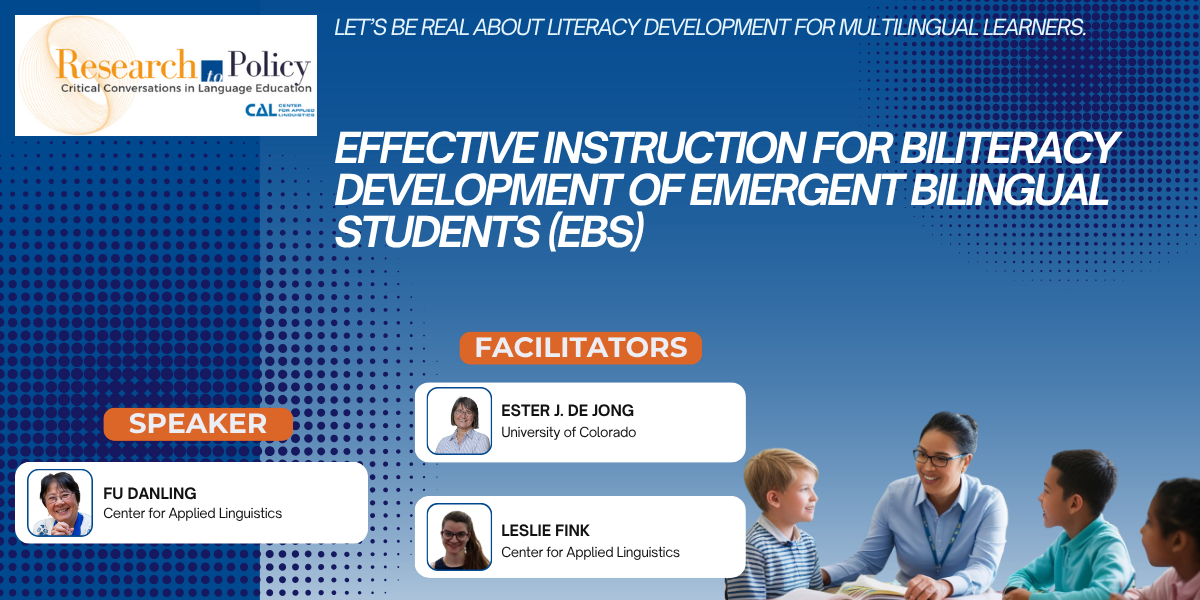
Effective Instruction for Biliteracy Development of Emergent Bilingual Students (EBs)

WEBINAR ANNOUNCEMENT

TITLE: Effective Instruction for Biliteracy Development of Emergent Bilingual Students (EBs)
DATE: December 9, 2025
TIME: 4:00–4:30 p.m. EDT

DETAILS:

In this session Dr. Danling Fu will share her perspectives of key principles of effective instruction for biliteracy development of emergent bilingual students, with a focus on writing development. Based on over three decades of working with teachers and students, she will highlight student-centered curriculum, the role of home language and translanguaging practice, and respect for the culture, language, and literacy experience that emergent bilinguals bring into our classrooms. Participants will gain insight into the intersections of research, policy, and practice, and explore what it takes to provide effective writing instruction for emergent bilingual students to develop their bilingual and biliteracy competence.

———————————————————————————————————————–

Important Notice on CAL Webinar Content

All webinars, recordings, and related materials produced by the Center for Applied Linguistics (CAL) are protected by copyright. They are made available exclusively through CAL’s official platforms for educational and informational purposes.

CAL does not authorize the reposting, redistribution, or resale of our webinars on any third-party websites. Any such uploads are unauthorized and may not accurately represent the original content.

To ensure you are accessing the most accurate, complete, and up-to-date info, please view webinars only through CAL’s official website and communication channels.


·   
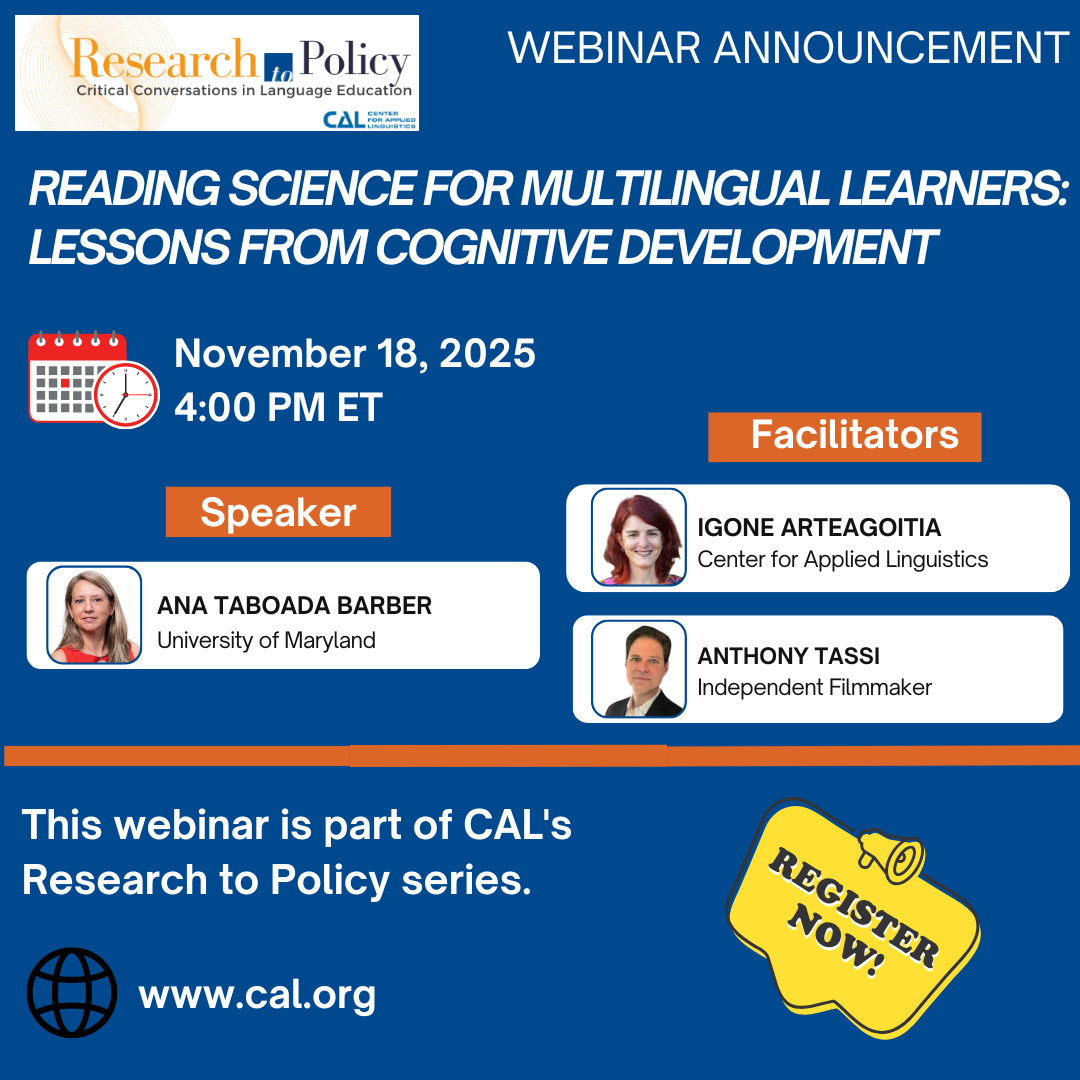
Reading Science for Multilingual Learners: Lessons from Cognitive Development

WEBINAR RECORDING

TITLE: Reading Science for Multilingual Learners: Lessons from Cognitive Development
DATE: November 18, 2025
TIME: 4:00–4:30 p.m. EDT

DETAILS:

In the United States (US), bilingual or Multilingual Learners (MLLs) tend to perform at grade level on word reading or decoding. However, scientific evidence shows that they tend to struggle with reading comprehension and with building knowledge from text throughout the elementary school years. Traditionally, vocabulary instruction has been leveraged to address many of MLLs’ needs in reading comprehension, yet this does not seem to be enough to address MLLs’ needs in understanding text. In fact, the history of bilingualism research shows that bilingualism has often been perceived as detracting to learning and reading, rather than contributing to it.  However, evidence from the last two decades and recent evidence point to the role that Executive Function (EF) skills might play as plausible drivers of reading comprehension in MLLs. In this webinar conversation with CAL colleagues, Ana Taboada Barber draws on existing research and her work on Executive Functions in MLLs and their English-monolingual peers to help shed light on how an asset-based approach to teaching MLLs can help broaden our understanding of their challenges with reading comprehension and knowledge-building from text. 

RESOURCES:

Reading Science for Emergent Bilinguals: Lessons From Bilingualism and Cognitive Research by Ana Taboada Barber (2025), The Reading Teacher: https://ila.onlinelibrary.wiley.com/doi/full/10.1002/trtr.70016

How Reading Motivation and Engagement Enable Reading Achievement: Policy Implications
Ana Taboada Barber (2020) ataboada@umd.edu
Volume 7, Issue 1. https://doi.org/10.1177/2372732219893385

———————————————————————————————————————–

Important Notice on CAL Webinar Content

All webinars, recordings, and related materials produced by the Center for Applied Linguistics (CAL) are protected by copyright. They are made available exclusively through CAL’s official platforms for educational and informational purposes.

CAL does not authorize the reposting, redistribution, or resale of our webinars on any third-party websites. Any such uploads are unauthorized and may not accurately represent the original content.

To ensure you are accessing the most accurate, complete, and up-to-date info, please view webinars only through CAL’s official website and communication channels.


·   
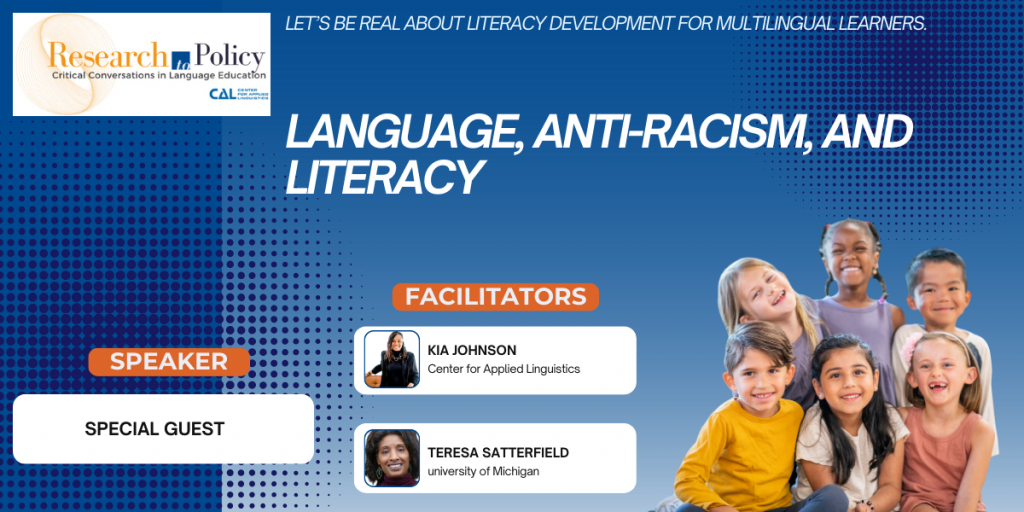
Language, Anti-Racism, and Literacy

WEBINAR ANNOUNCEMENT

TITLE: Language, Anti-Racism, and Literacy
DATE: September 9, 2025
TIME: 4:00–4:30 p.m. EDT

DETAILS:

This session will center a critical conversation on the intersections of language, anti-racism, and literacy within multilingual contexts. Facilitators and our special guest will explore how research on linguistic justice challenges traditional views of “standard” English and raises important questions for educators and policymakers about equity in literacy education. Participants will gain insight into current scholarship, hear reflections on the implications for classroom practice and policy, and consider what it means to cultivate literacy learning environments that affirm and sustain students’ diverse linguistic identities.

RESOURCES:

Black Language Syllabus website

Linguistic Justice: Black Language, Literacy, Identity, and Pedagogy by Dr. April Baker-Bell (chapter 6 is currently open access

Linguistic Justice Book Trailer

———————————————————————————————————————–

Important Notice on CAL Webinar Content

All webinars, recordings, and related materials produced by the Center for Applied Linguistics (CAL) are protected by copyright. They are made available exclusively through CAL’s official platforms for educational and informational purposes.

CAL does not authorize the reposting, redistribution, or resale of our webinars on any third-party websites. Any such uploads are unauthorized and may not accurately represent the original content.

To ensure you are accessing the most accurate, complete, and up-to-date info, please view webinars only through CAL’s official website and communication channels.


·   
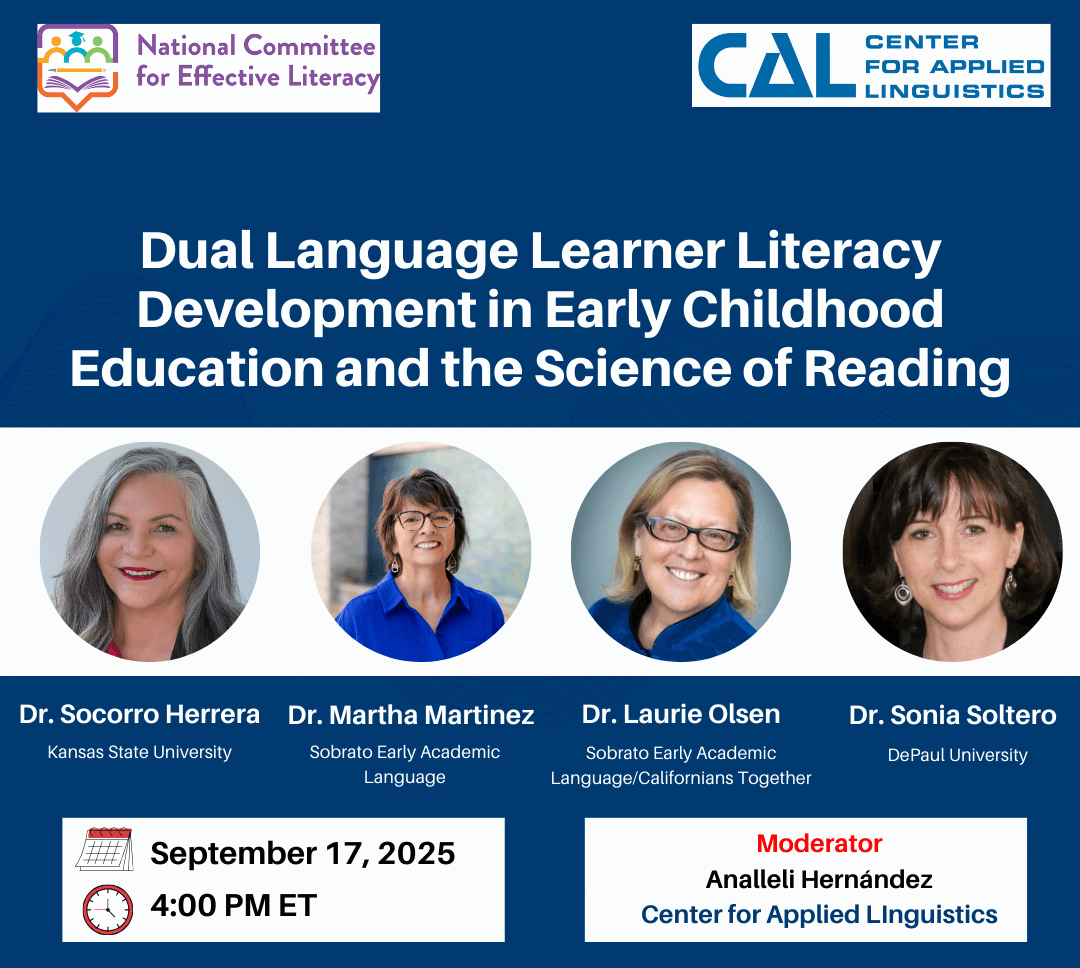
Dual Language Learner Literacy Development in Early Childhood Education and the Science of Reading

WEBINAR RECORDING

TITLE: Dual Language Learner Literacy Development in Early Childhood Education and the Science of Reading
DATE: September17, 2025
TIME: 4:00–4:30 p.m. EDT

DETAILS:

Leading researchers and educators shared insights into the unique language and literacy development of young dual language learners, grounded in decades of research on bilingualism, biliteracy, and second language acquisition. The panel highlighted developmentally, culturally, and linguistically responsive strategies that foster language-rich environments and build strong foundations for literacy.

Panelists also reflected on how these evidence-based approaches align—or conflict—with today’s prevailing literacy initiatives, including the Science of Reading.

Presenters:
• Dr. Sonia Soltero, DePaul University
• Dr. Socorro Herrera, Center for Intercultural and Multilingual Advocacy, Kansas State University
• Dr. Martha Martínez, SEAL
• Dr. Laurie Olsen, SEAL / Californians Together

Moderator:
• Analleli Hernández, Center for Applied Linguistics

RESOURCES

Supporting Dialect and Vernacular Language Speakers in the Literacy Classroom

WEBINAR RECORDING

TITLE: Supporting Dialect and Vernacular Language Speakers in the Literacy Classroom
DATE: August 12, 2025
TIME: 4:00–4:30 p.m. EDT

DETAILS:

Students who speak dialects and Creole languages at home make up a significant and growing portion of classrooms across North America. In the U.S., this population is largely represented by speakers of vernacular dialects such as African American Vernacular English (AAVE) as well as English-based Creoles spoken in many immigrant communities (e.g., Jamaican Creole).

Given the unique relationship between these home languages and standardized English, students often encounter distinct challenges in learning to read and write. At the same time, they bring valuable linguistic strengths that are frequently misunderstood or overlooked in instructional policy and practice. These students are often underserved in language and literacy classrooms—not due to a lack of potential, but because their language backgrounds do not entirely align with common models of English language support (e.g., ESL provisions).

This webinar invites educators, administrators, and decision-makers to explore how we can better support the literacy development of students who speak dialects and primarily use oral languages. We’ll consider: What are the most pressing issues facing this student population? What changes in classroom practice and policy could make a difference? What actions can district and school leaders take to create more linguistically responsive systems?

Join Dr. Shawna-Kaye Tucker and the CAL team in what promises to be an insightful and productive conversation.

SPEAKER:

Dr. Shawna-Kaye Tucker is an assistant professor of Applied Linguistics at OISE, University of Toronto. Her research focuses on the language and literacy development of learners with English as an additional language, with a particular emphasis on writing. As a Caribbean native, she carries out extensive work with children who speak dialects and Creole languages–– exploring how schools can best support English literacy development through evidence-based practices that validate learners’ linguistic resources.

——————————————————————————————————————–

Important Notice on CAL Webinar Content

All webinars, recordings, and related materials produced by the Center for Applied Linguistics (CAL) are protected by copyright. They are made available exclusively through CAL’s official platforms for educational and informational purposes.

CAL does not authorize the reposting, redistribution, or resale of our webinars on any third-party websites. Any such uploads are unauthorized and may not accurately represent the original content.

To ensure you are accessing the most accurate, complete, and up-to-date info, please view webinars only through CAL’s official website and communication channels.

Literacy Practices and Students with Interrupted Formal Education

WEBINAR RECORDING

TITLE: Literacy Practices and Students with Interrupted Formal Education
DATE: July 8, 2025
TIME: 4:00–4:30 p.m. EDT

DETAILS:

In this timely webinar, we explore critical questions at the intersection of literacy development and educational equity for multilingual learners with limited or interrupted formal education (SLIFE). Part of our Research to Policy: Critical Conversations in Language Education series, this 30-minute session brings together educators, researchers, and policy advocates to examine the unique needs of students entering schools with gaps in formal education, many of whom are learning new languages while adapting to unfamiliar systems and social environments.

Our featured guest, Dr. Michelle Marrero Colón, is a scholar-practitioner who researches best practices for multilingual learners—especially SLIFE—and applies her findings directly in the classroom. Her insights bridge academic research and real-world application, offering practical strategies grounded in both evidence and experience.

Dr. Marrero Colón will be joined by facilitators Dr. Marguerite Lukes and Marybelle Marrero Colón for a dynamic conversation on how schools can respond more effectively to the literacy needs of SLIFE students. Topics include dual language literacy, professional learning for educators, social-emotional supports, and schoolwide models that center student dignity and growth.

This session is designed to inspire action and inform equitable practices in classrooms, schools, and policy spaces.

Join us to explore:

• How schools can better identify and support SLIFE students
• What practices are most effective in building emergent literacy
• Why shared responsibility and strategic resource allocation are critical to success

RESOURCES

————————————————————————————————————————

Important Notice on CAL Webinar Content

All webinars, recordings, and related materials produced by the Center for Applied Linguistics (CAL) are protected by copyright. They are made available exclusively through CAL’s official platforms for educational and informational purposes.

CAL does not authorize the reposting, redistribution, or resale of our webinars on any third-party websites. Any such uploads are unauthorized and may not accurately represent the original content.

To ensure you are accessing the most accurate, complete, and up-to-date info, please view webinars only through CAL’s official website and communication channels.

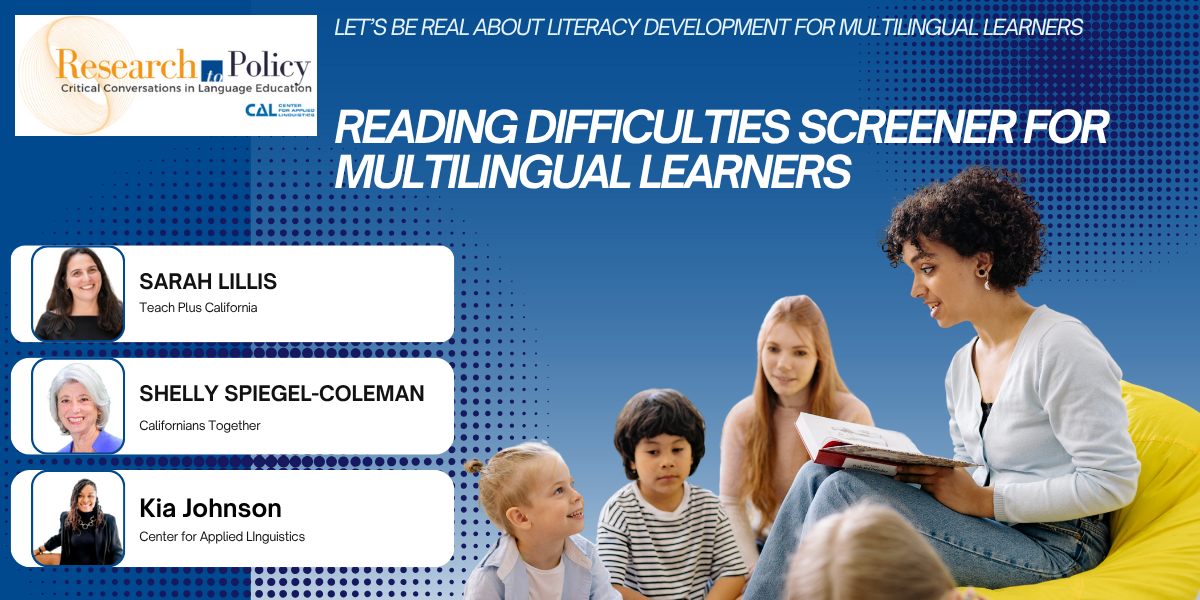
Assessing Reading Difficulty Screeners for Multilingual Learners

WEBINAR RECORDING

TITLE: Assessing Literacy Reading Difficulty Screeners for Multilingual Learners
DATE: June 10, 2025
TIME: 4:00–4:30 p.m. EDT

DETAILS:

Forty states have adopted a variety of early literacy screeners. It is critical that these tools support, not hinder multilingual learners. Join us for a timely 30-minute webinar that explores how to equitably implement reading difficulties risk screeners for multilingual learners in early grades.

Drawing on insights from the recent publication, Reading Difficulties Screener for Multilingual Learners, our expert speakers will highlight key considerations for district leaders, educators, and assessment teams, including:

  • How to select and implement screeners with multilingual learners in mind
  • Strategies for interpreting results accurately and equitably
  • Guidance for communicating results with families and vendors
  • Questions every district should ask during adoption and implementation

This brief and powerful session will provide the foundational knowledge and practical tools you need to align your screening practices with current mandates, while centering equity for your multilingual students.

RESOURCES

———————————————————————————————————————

Important Notice on CAL Webinar Content

All webinars, recordings, and related materials produced by the Center for Applied Linguistics (CAL) are protected by copyright. They are made available exclusively through CAL’s official platforms for educational and informational purposes.

CAL does not authorize the reposting, redistribution, or resale of our webinars on any third-party websites. Any such uploads are unauthorized and may not accurately represent the original content.

To ensure you are accessing the most accurate, complete, and up-to-date info, please view webinars only through CAL’s official website and communication channels.

Literacy Practices for Multilingual Students with Disabilities

WEBINAR RECORDING

TITLE: Literacy Practices for Multilingual Students with Disabilities
DATE: May 13, 2025
TIME: 4:00–4:30 p.m. EDT

DETAILS:
Numerous questions exist in the field regarding the identification and support of multilingual learners with disabilities. In addition, many myths about these learners’ literacy abilities and needs persist in education. In this webinar, Dr. Durán and Dr. Kangas shared best practices and future directions for improving current approaches to nurturing and accurately assessing the literacy development of MLs with disabilities.

RESOURCES:

Reading Reform Across America
https://www.shankerinstitute.org/read

MTSS for ELs
https://www.mtss4els.org

Multitudes
https://dyslexia.ucsf.edu/Multitudes

How States Identify English Learners, Including Those with Disabilities
https://www.gao.gov/products/gao-24-107376

———————————————————————————————————————

Important Notice on CAL Webinar Content

All webinars, recordings, and related materials produced by the Center for Applied Linguistics (CAL) are protected by copyright. They are made available exclusively through CAL’s official platforms for educational and informational purposes.

CAL does not authorize the reposting, redistribution, or resale of our webinars on any third-party websites. Any such uploads are unauthorized and may not accurately represent the original content.

To ensure you are accessing the most accurate, complete, and up-to-date info, please view webinars only through CAL’s official website and communication channels.

Comprehensive Literacy Approach for Multilingual Learners

VIEW THE RECORDING

TITLE: Comprehensive Literacy Approach for Multilingual Learners
DATE: April 15, 2025
TIME: 4:00–4:30 p.m. EDT

DETAILS:
There are many questions in the field about identifying and supporting multilingual learners with disabilities. In addition, many myths about the literacy abilities and needs of these learners persist in education. In this webinar, Dr. Durán and Dr. Kangas will share best practices and future directions to improve current approaches in nurturing and accurately assessing the literacy development of MLs with disabilities.

————————————————————————————————————————

Important Notice on CAL Webinar Content

All webinars, recordings, and related materials produced by the Center for Applied Linguistics (CAL) are protected by copyright. They are made available exclusively through CAL’s official platforms for educational and informational purposes.

CAL does not authorize the reposting, redistribution, or resale of our webinars on any third-party websites. Any such uploads are unauthorized and may not accurately represent the original content.

To ensure you are accessing the most accurate, complete, and up-to-date info, please view webinars only through CAL’s official website and communication channels.

AI for Empowering Educators: Transforming Support for Newcomers and English Learners

WEBINAR RECORDING

TITLE: AI for Empowering Educators: Transforming Support for Newcomers and English Learners
DATE: Jan 29, 2025
TIME: 4:00–4:30 p.m. EDT

DETAILS:
Discover how Artificial Intelligence can revolutionize teaching practices for educators working with Newcomers and English Learners. This session explored practical AI tools and strategies to personalize learning, enhance language development, and streamline teacher workflows, empowering educators to better meet the unique needs of multilingual students.

RESOURCES

https://tovar.us


Important Notice on CAL Webinar Content

All webinars, recordings, and related materials produced by the Center for Applied Linguistics (CAL) are protected by copyright. They are made available exclusively through CAL’s official platforms for educational and informational purposes.

CAL does not authorize the reposting, redistribution, or resale of our webinars on any third-party websites. Any such uploads are unauthorized and may not accurately represent the original content.

To ensure you are accessing the most accurate, complete, and up-to-date info, please view webinars only through CAL’s official website and communication channels.